We Are What’s Left: a field guide.
The tools, collections and working files in We Are What’s Left. Open an entry for its description and follow the link when you are ready to explore.
 ← Read the complete Bunker field guide
Open a bullet to read more. Each entry has a link to the working file.
We Are What’s Left
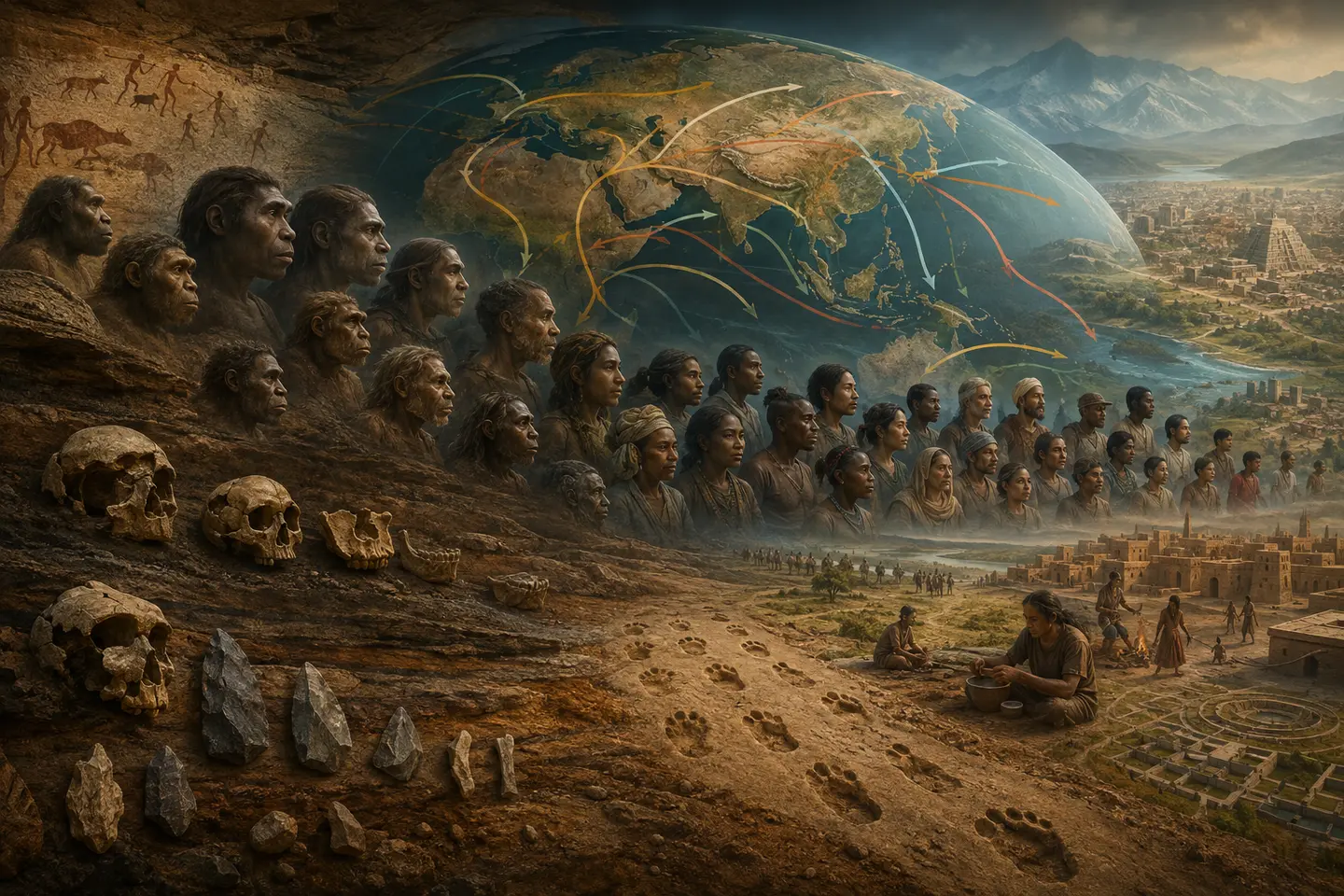
The human story has branches, overlaps and a lot of unfinished arguments. WAWL brings the people, places and evidence into the same picture.
Species pictures are reconstructions. Sources and uncertainty matter more than a tidy family tree.
The Story So Far
Follow the branching human story through deep time. Pause at a turning point, examine the fossil or discovery behind it, and keep uncertain placements separate from established relationships.
Open The Story So FarHuman Family
Meet human species, ancestral populations and side branches. Use the family view to connect a name with its anatomy, place in time and the evidence behind its proposed relationships.
Open Human FamilyCurrent Understanding
Get your bearings in the current picture of human life: food, tools, relationships, adaptation and community. Read the evidence notes alongside reconstructions rather than treating an illustration as a fossil record.
Open Current UnderstandingAtlas
Explore the human past by time and place. Move through the timeline, search the map and open a record to examine the sources and uncertainty behind its position.
Open AtlasReports
Read species and population dossiers in greater detail. Connect anatomy, chronology and relationships with their sources, and check which questions remain unsettled.
Open ReportsPlants + Animals
Explore plants and animals in the human story. Follow cultivation, domestication, hunting and other relationships while keeping species, populations and human-made varieties distinct.
Open Plants + AnimalsCivilizations
Explore early cultural and technological worlds through their surviving material evidence. Check the scope of each record; the collection does not imply that every later civilization is already covered.
Open CivilizationsNews
Read research reporting and updates, with dates and sources close to the finding. Follow the underlying paper before extending a reported result beyond its stated evidence.
Open NewsTheories
Inspect competing explanations and the evidence used to support them. Compare what an explanation predicts with what has been observed, and keep open questions visible.
Open TheoriesAbout the Evidence
Review the methods, confidence labels, citations and ethical boundaries behind the archive. Use it to understand how the site distinguishes observation, inference and illustrative scenarios.
Open About the EvidenceEvidence Workspace
Inspect evidence coverage, claims and source changes in a dedicated workspace. Follow a claim back to its record and use the visible limitations when deciding how much weight it can carry.
Open Evidence WorkspaceDiscoveries
Explore archaeological and evolutionary findings and their implications. Follow the dated evidence behind a discovery, including the limits that can be lost in a short headline.
Open DiscoveriesResearch
Browse research findings and their supporting sources. Use the linked records to distinguish a new observation from an interpretation or a question that still needs better evidence.
Open ResearchScientific Monitoring
Inspect the source-update and research-monitoring status. A successful source check is a statement about coverage and retrieval; it is not independent verification of every scientific claim.
Open Scientific MonitoringKnown Unknowns
Look directly at gaps in the evidence and questions that remain open. Use them as starting points for investigation rather than filling the missing pieces with a neat story.
Open Known UnknownsProblematica
Explore disputed taxa, unstable names and mismatches between classifications and lineages. Read the competing placements and the evidence needed to settle them.
Open ProblematicaPublic Claim Registry
Inspect public claims together with their review dates and revision histories. Follow changes over time instead of assuming that a once-published interpretation is permanent.
Open Public Claim RegistryIn Review
Read selected monthly, yearly and decade reviews of research. Each review has its own coverage window and limits; a selected synthesis is not a complete census of the literature.
Open In ReviewSource Registry
Find source records and the parts of the archive that cite them. Use the registry to move from a summary to the underlying paper or other original evidence.
Open Source RegistryCorrections
Follow changes to the evidence record. Check what was corrected and why, keeping scientific revisions separate from ordinary interface updates.
Open CorrectionsCoverage
Inspect where the archive has evidence and where it has gaps. Use the coverage context before treating an empty area or an absent record as proof of absence.
Open CoveragePublic Feedback
Report a problem, suggest a source or raise a concern about a record. Give the relevant page and evidence so the issue can be examined in context.
Open Public FeedbackCulture Before Us
Explore material and social evidence for human cultural life. Keep the surviving objects and observations alongside the interpretations drawn from them.
Open Culture Before UsFood + Cooking
Explore food, cooking and ecological relationships in the human past. Follow the evidence for an activity without assuming that every plausible reconstruction is directly observed.
Open Food + CookingMade by Humans
Explore plants, animals and other life shaped by people. Compare breeding, cultivation and other human influences while preserving the biological and historical distinctions.
Open Made by HumansHigh-impact Events
Explore changes with major consequences across human history. Read each event in its place and time, including the evidence limits around its proposed impact.
Open High-impact EventsFrom the Desk
A planned home for essays and field notes by A.R. Schneider. This destination currently introduces the collection; it is not a claim that the full essay archive is published.
Coming soon — this destination currently describes planned work.Open From the DeskMedia Library
Browse videos, playlists and teaching materials. Check the access labels and source context before using a media item as evidence for a particular claim.
Open Media LibraryClassroom Studio
A planned studio for guided classroom investigations. The page describes the direction of the work; it is not an available course or a completed learning program.
Coming soon — this destination currently describes planned work.Open Classroom StudioCompare Records
Open records side by side in the comparison workspace. Change the selection and examine relationships, evidence and differences without losing the context of each record.
Open Compare RecordsEnrichment Lab
A planned set of ways to turn curiosity into stronger research questions. Read the current direction here while the broader tools remain in preparation.
Coming soon — this destination currently describes planned work.Open Enrichment LabVisual Insights
Explore visual explanations of evidence and relationships. Read the accompanying labels so a diagram or reconstruction is not mistaken for a direct measurement.
Open Visual InsightsResearch Transfer
Planned tools for taking research between workspaces. The current page describes that direction; do not rely on it as a completed backup or migration service.
Coming soon — this destination currently describes planned work.Open Research TransferCommunity Standards
Read the community rules and limits on participation. These standards explain the expected conduct and evidence boundaries around contributions.
Open Community StandardsPrivacy
Read the site’s explanation of data use and contact information. Check this page before sharing personal information or using a feature that stores research.
Open Privacy